How Language Models Are Built
At this point, almost everyone is familiar with AI tools like ChatGPT, Google Gemini, and Anthropic’s Claude. These web-based tools seem capable of answering any question, writing code, and generating images or short videos. Most of them allow users to have conversations, upload documents, and paste web links. The web interfaces themselves are simply the front ends for the underlying technology. At the core of these systems is a language model, or a multimodal model capable of processing more than just language. To truly understand how they work, let’s focus on the language models themselves.
Learning Objectives
At the end of this lesson, you should be able to:
- Define a language model and its fundamental function as a text generator.
- Outline the five key stages of the language model building pipeline.
- Describe the roles of pretraining and instruction tuning in developing language models.
- Identify several common benchmarks used to evaluate language model performance.
- Explain how guardrails are implemented throughout the language model lifecycle to ensure safety.
What Is a Language Model?
At the most basic level, a language model is a sophisticated text generator. Given a sequence of tokens (which can be words or subwords), it computes a probability distribution over what comes next. In other words, when text is input into a language model, it predicts what comes next, thereby coherently and meaningfully completing or continuing the text. Such a language model is known as a base model. The models that sit at the center of most consumer-facing AI assistants aren’t base models; these are known as chat models or conversational models. The difference lies in their training.
Language Model Building Pipeline
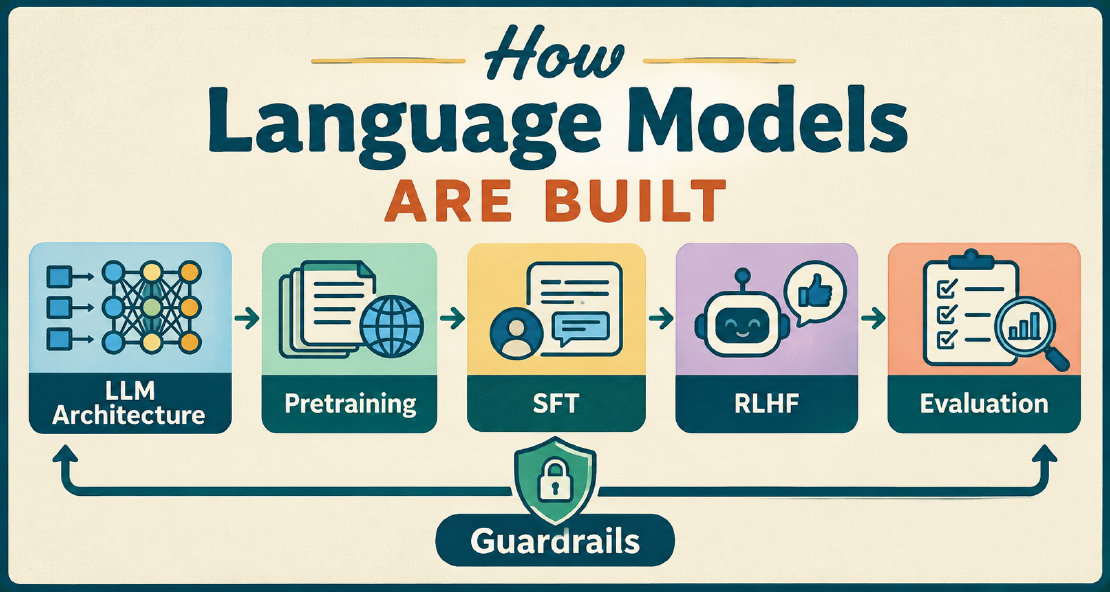
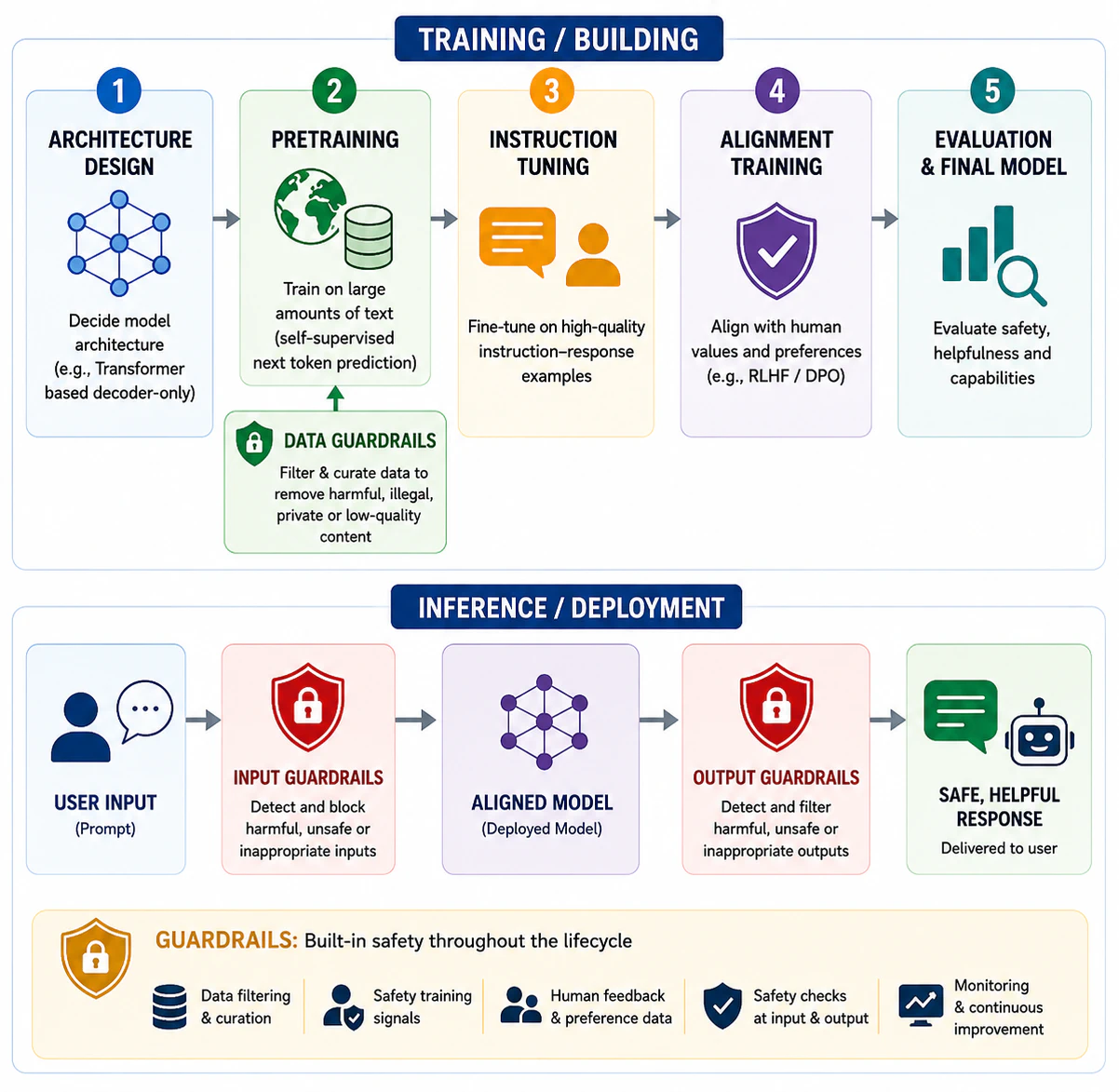
Transforming a base model into a conversational assistant involves a structured language model building pipeline. This process moves through five key stages: defining the neural network architecture, pre-training on vast datasets, supervised fine-tuning for instruction following, aligning the model with human preferences, and performing comprehensive evaluation. Throughout this lifecycle, safety guardrails are implemented to govern both the building phase and the final inference stage where the model interacts with users. The following infographic illustrates this progression and the integrated role of these guardrails.
1. Architecture Design
The first step in the language model building pipeline involves selecting the neural network architecture. Frontier models like ChatGPT, Claude, and Gemini use the industry-standard Transformer-based decoder-only architecture. This architecture uses a mechanism called attention to understand the relationships between words, regardless of how far apart they appear in a passage. Because this structure is optimized to predict the next word in a sequence, it provides the ideal foundation for generating fluid, human-like conversation.
2. Pretraining
A base model is trained with a large amount of text (often scraped from the web) in a self-supervised manner. This process is known as pretraining. To achieve this, the training algorithm moves a sliding text window across a sentence to create input and target pairs. For example, using the sentence “Language models are text generators with emerging problem-solving abilities” and a fixed window of three words (tokens), the algorithm first uses “Language models are” as the context and predicts the word “text.” It then slides the window forward by one word so that “models are text” becomes the context and predicts “generators.” Since the target word is already embedded in the original text, the system requires no manual human labeling, which is exactly why the process is described as self-supervised. By repeating this across a massive corpus, the algorithm generates the trillions of training examples needed for the model to internalize the complex statistical patterns of human language.
The model learns to predict the next token
3. Instruction Tuning
Conversational models are derived from base models through additional instruction tuning and alignment training. Instruction tuning is a supervised fine-tuning (SFT) technique where a pre-trained language model is trained on a dataset comprising instructions and their corresponding desired outputs. This process enhances the model’s ability to interpret and execute diverse prompts, moving beyond general text completion towards task-specific instruction following. For example, a model might be trained on pairs such as:
Q: Summarize the following text: [text] A: [summary]
or
Q: Translate ‘Bonjour’ to English. A: ‘Hello’
4. Alignment Training
Alignment training, a broader concept, is a comprehensive process aimed at ensuring a language model’s behavior aligns with human values, preferences, and safety standards. While instruction tuning is a key component, alignment often extends to methods like Reinforcement Learning from Human Feedback (RLHF), where human evaluators provide feedback on model responses, which is then used to refine the model’s policy.
The supervised fine-tuning phase of alignment training also leverages question-answer pairs to instill desired behaviors or refusal patterns. Examples include training on:
Q: Provide a recipe for cookies. A: [safe, clear recipe]
versus
Q: How do I commit fraud? A: I cannot assist with harmful or illegal requests.
This teaches the model to generate helpful, harmless, and honest responses, thereby aligning its outputs with ethical guidelines.
5. Evaluation
After a model has been refined through Supervised Fine-Tuning (SFT) and Reinforcement Learning from Human Feedback (RLHF), it undergoes a final quality assurance phase to ensure it is ready for the real world. This step is a rigorous stress test designed to verify that the training translated into reliable behavior without causing catastrophic forgetting, which is a phenomenon where the model loses old skills while learning new ones. Developers utilize holistic benchmarks to act as final exams for specific capabilities like logic and coding.
Much like academic exams, these benchmarks provide standardized frameworks for assessing a language model’s performance across a wide range of applications. They offer a consistent way to measure how well a model performs tasks such as text generation, summarization, and code completion. Using language model benchmarks is essential when selecting a model because they enable comparisons across different models and domains. By leveraging these benchmarks, you can identify which models excel in specific areas and make informed decisions about which one best suits your needs.
Following are some of the most widely used language model benchmarks, which have become essential tools for evaluating the performance of large language models.
MMLU: A benchmark consists of 15,908 multiple-choice questions spanning 57 different topics, from math and anatomy to US history and law.
GPQA: A challenging graduate-level multiple-choice question set crafted by domain experts, including 198 questions. Think of it as a super-difficult version of MMLU.
ARC: Includes grade-school science questions that test a model’s ability to understand scientific concepts.
HellaSwag: A benchmark for common-sense reasoning, where the model is provided with the beginning of a sentence and must choose between potential continuations.
TruthfulQA: This benchmark measures a model’s propensity to reproduce falsehoods found online.
Winogrande: A common-sense reasoning benchmark that tests a model’s ability to understand everyday situations.
GSM8K: A benchmark containing grade-school math word problems, making it great for measuring the ability to solve multi-step math reasoning problems.
HumanEval: A benchmark that measures functional correctness by generating code. It includes 164 Python programming problems that test a model’s ability to write correct and efficient code.
Benchmarks for language models can be run in two distinct modes: zero-shot and few-shot learning. In zero-shot learning, the language model is prompted without any specific examples, relying solely on its general understanding of the task to generate accurate results. This approach leverages the model’s ability to generalize from broad concepts to new scenarios.
In contrast, few-shot learning presents the language model with several concrete examples of task performance. By learning from these instances, the model can adapt more effectively to new scenarios and improve its overall accuracy.
To evaluate the nuances of the model’s conversational style, developers often employ a technique called language model as a judge, where an even more advanced model grades the new model’s responses for accuracy and helpfulness.
Finally, the model undergoes red teaming, where human experts attempt to provoke the AI into generating harmful content to ensure its safety guardrails are robust. This multi-layered process serves as the final technical checkpoint before the model is approved for production.
Guardrails
Guardrails are the critical safety systems used to govern language models at every stage of their development and use. In the model building pipeline, data guardrails are the first line of defense, as they are used to strip away private information and toxic content from training datasets before the model ever sees them. This is reinforced during alignment training, where the model learns to follow human values through explicit feedback. Once the model is active, additional guardrails are applied during inference time to provide real-time protection. Input guardrails analyze user prompts to identify and block malicious intent or attempts to bypass safety rules. Simultaneously, output guardrails act as a final filter, scanning the generated text for hallucinations or sensitive data before it is displayed to the user. This multi-stage approach ensures that safety is both baked into the model and enforced during every interaction.
Final Thoughts
The journey from a basic text generator to a sophisticated conversational AI involves a meticulous, multi-stage pipeline. Starting with a Transformer-based architecture, models undergo extensive pretraining on vast datasets, followed by instruction tuning and alignment training to instill desired behaviors and safety protocols. Rigorous evaluation using diverse benchmarks and red teaming ensures the model’s reliability and ethical adherence. Ultimately, robust guardrails, implemented at every phase from data preparation to real-time inference, are essential for developing AI systems that are not only powerful but also safe, helpful, and aligned with human values.
Related Posts

LLM Settings
Large language models offer a suite of adjustable settings that enable users to precisely customize their output and behavior. These parameters, including temperature, top p, frequency and presence penalties, maximum sequence length, stop sequences, and context length, are fundamental to controlling aspects such as the randomness, diversity, and structure of generated text.
Read more
Tokenization and Text Embedding
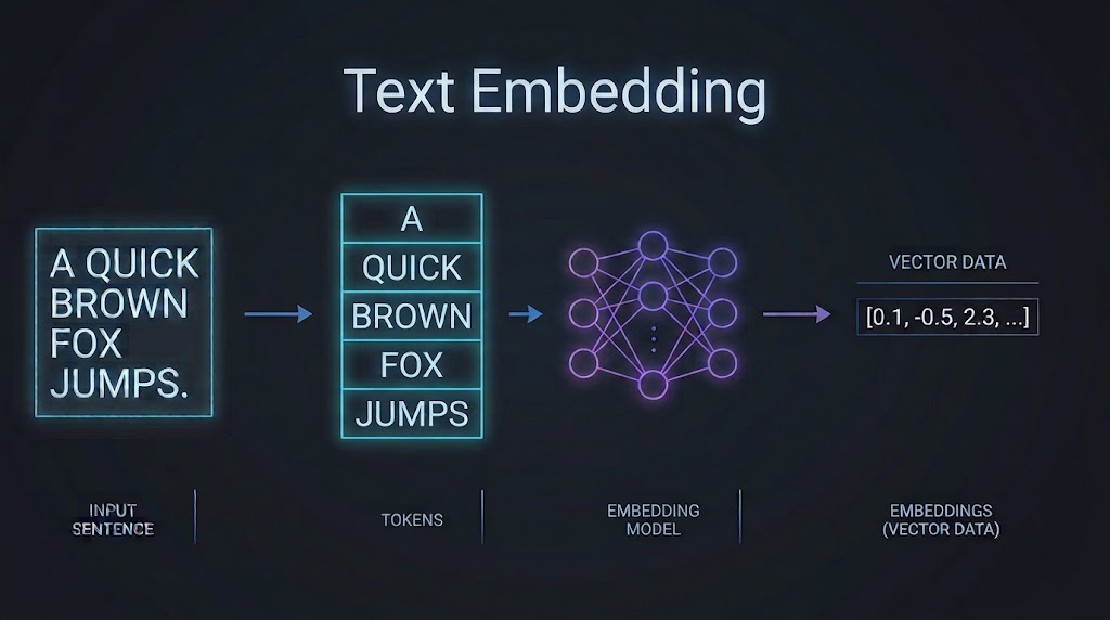
Ever wondered how modern AI systems understand human language? At their core, Large Language Models (LLMs) never actually see or read words as humans do.
Read more